Roberts and Ward: following the language of sensation
“As if” and “as though” introduce a comparison: a person is describing how something feels, not necessarily naming what is physically happening. Roberts and Ward collected this subjective language in two repertories that were the final subject of our 2020 classical spotlight series.
The newsletter’s central distinction remains useful. Roberts arranges subjective symptoms in a Kentian hierarchy; Ward presents them in a compact format centred on short expressions. Both deserve to be read with attention to the language from which the entries were drawn.
Roberts preserves a detailed description
Herbert Roberts’ Sensations as if draws on source texts including Hering, Allen, Clarke, Yingling and Anschutz. Its hierarchy lets the reader follow a subjective description within an organised repertory structure.
The accompanying introduction highlights its many single-remedy entries and its value for studying strongly described sensations. In this context, a rare expression is something to investigate in the literature. It is not, on its own, a diagnosis or an instruction to prescribe.
Ward offers a compact route through words
Ward’s work uses brief expressions for subjective symptoms. The newsletter particularly recommended it for reverse repertorisation: beginning with a remedy and studying the entries in which it appears. This reverses the usual direction of moving from a symptom description towards a list of remedies.
The original RadarOpus demonstration also takes several sensation keywords into separate search tabs and compares their results graphically. It then returns from a selected remedy to the relevant text. The useful movement is from words to an overview, and from that overview back to the passages themselves.
Keep the phrase as well as the keyword
A keyword search gives you matches, but the surrounding phrase tells you what each match means. Read the whole entry before treating two results as equivalent. A compact index and a detailed hierarchy may lead to overlapping material while preserving different amounts of context in the heading.
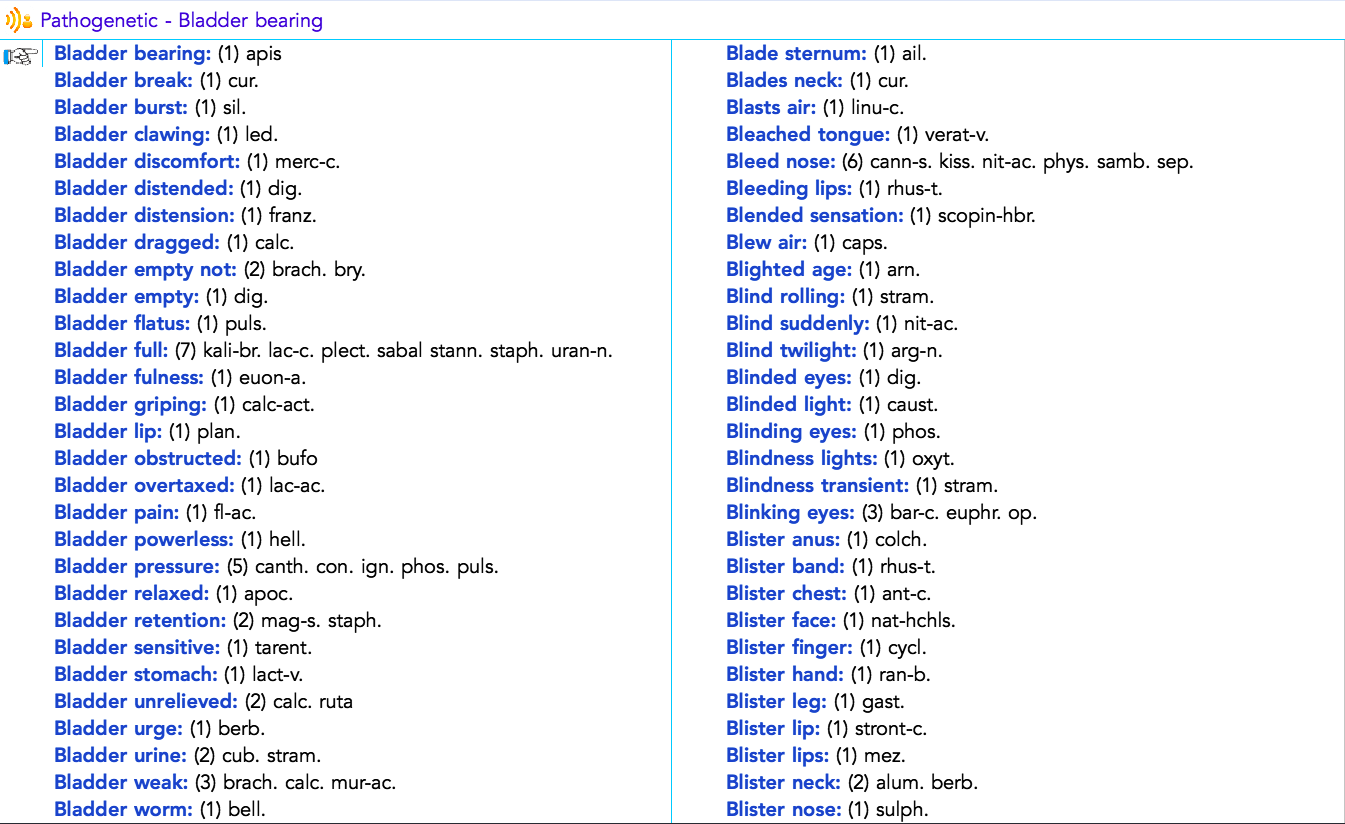
The illustration above comes from Ward’s original 2020 demonstration. It is retained as a historical view of the material, not a current toolbar guide. The source galleries allow the two approaches to be compared in sequence.
Read the Roberts introduction and explore Ward’s keyword and reverse-repertorisation examples.
Adapted from Luke Norland’s Zeus Soft teaching newsletter of 28 November 2020, with the accompanying repertory reading.
This article is for educational purposes and does not replace individual medical advice. Seek appropriate medical care for health concerns and continue any prescribed treatment.