Phatak’s Concise Repertory: keeping the wider pattern in view
Phatak’s Concise Repertory was the fourth subject in the 2020 classical-repertory series. The newsletter introduced a work that draws together material from Boger, Bönninghausen, Kent, Boericke, Burnett and Clarke, alongside Phatak’s own experience. The accompanying article explains why its concise, alphabetical arrangement asks the reader to think differently from a long sequence of increasingly narrow subrubrics.
Read across the account
The teaching page places Phatak within the Boger–Bönninghausen tradition of generalisation. Its emphasis is on affinities, the wider sphere of a complaint, and sensations that recur across different parts of an account. These are considered alongside the circumstances that modify the symptoms.
The original explanation contrasts this with following a detailed hierarchy from a broad heading to a highly specific particular. Neither arrangement can be understood simply by counting the number of entries. The distinction is how each repertory organises what the reader is trying to express.
What belongs in the wider pattern?
The accompanying outline of a genius analysis asks the reader to consider several kinds of information:
- The nature of the pathological process and the organs or tissues involved.
- The circumstances associated with the onset of the complaint.
- Aggravating and ameliorating conditions that apply generally.
- Sensations or traits recurring through the account.
- Relevant phases of life and constitutional features.
- Particularly distinctive features that still need to be kept in view.
These headings describe the approach presented in the source. They are not a checklist from which to invent missing information. Their purpose in study is to show what the repertory’s broad entries are intended to represent.
Concise does not mean context-free
A short heading still needs careful reading. The newsletter’s point was that Phatak selected and brought together material from several classical repertories, rather than merely shortening a modern repertory. Comparing the same subject across those works can therefore reveal differences in emphasis as well as differences in wording.
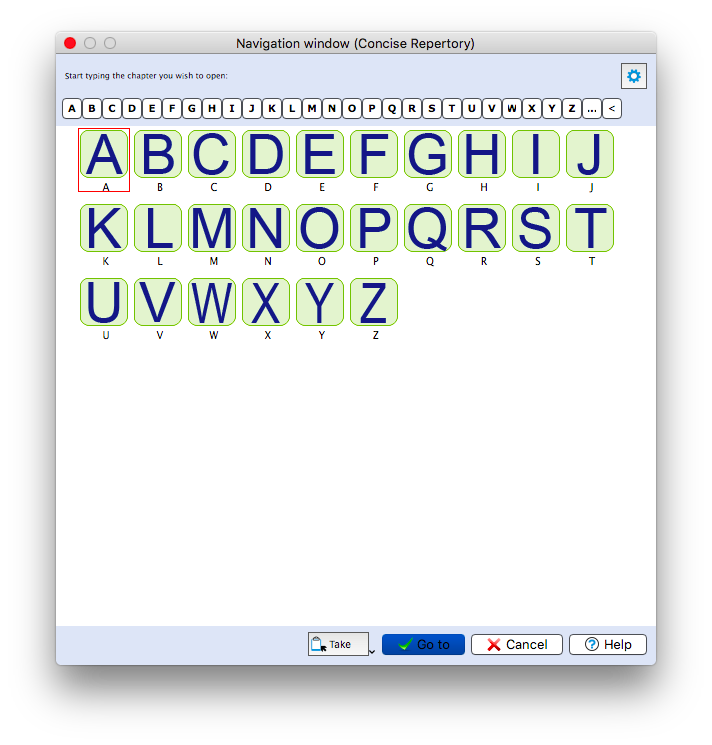
The image above is the alphabetical navigation window from the original 2020 demonstration. It illustrates the arrangement of the book; it is not a claim that today’s interface is identical.
Read the introduction to Phatak’s Concise Repertory and its gallery. The classical repertories guide places it alongside the other works in this series.
Adapted from Luke Norland’s Zeus Soft teaching newsletter of 14 November 2020, with the accompanying repertory reading.
This article is for educational purposes and does not replace individual medical advice. Seek appropriate medical care for health concerns and continue any prescribed treatment.