Clarke’s Clinical Repertory: another route into Materia Medica
Clarke’s Clinical Repertory is a companion to his Dictionary of Practical Materia Medica. That relationship is the useful starting point. The repertory offers ways into the material; the dictionary supplies the fuller descriptions to which those entries lead.
Our November 2020 newsletter introduced Clarke as a way of comparing lesser-known remedies with the familiar polychrests after a conventional repertorisation. The educational interest was in what a different index could bring to the reader’s attention.
Three sections, different questions
The work is arranged into Clinical, Causation and Temperaments. Its Clinical section is alphabetical and uses the language of conditions among its headings. Causation directs attention to the circumstances associated with a complaint; Temperaments provides another part of Clarke’s organisation of the material.
Knowing which section you are reading matters. A clinical heading, a causal relationship and a temperament do not say the same thing. A useful study note records the section and full entry, rather than preserving a remedy list without its context.
Compare what different indexes bring forward
The original teaching page compares clinical rubrics from Clarke with related entries in Synthesis. Its purpose is to notice remedies that may be less conspicuous in a larger repertory. This is a comparison of how the books represent their literature, not evidence that a shorter list necessarily supplies a better answer.
The newsletter also emphasised using a clinical condition as an entry point into Materia Medica reading. That gives the repertory a role beyond assembling an analysis: it can help organise a reading session around a particular heading and the remedies indexed beneath it.
Return to the companion text
Once an unfamiliar remedy comes into view, follow it into the dictionary and read the description around the relevant feature. Keep the repertory entry beside the fuller account so that the relationship between index and source remains visible.
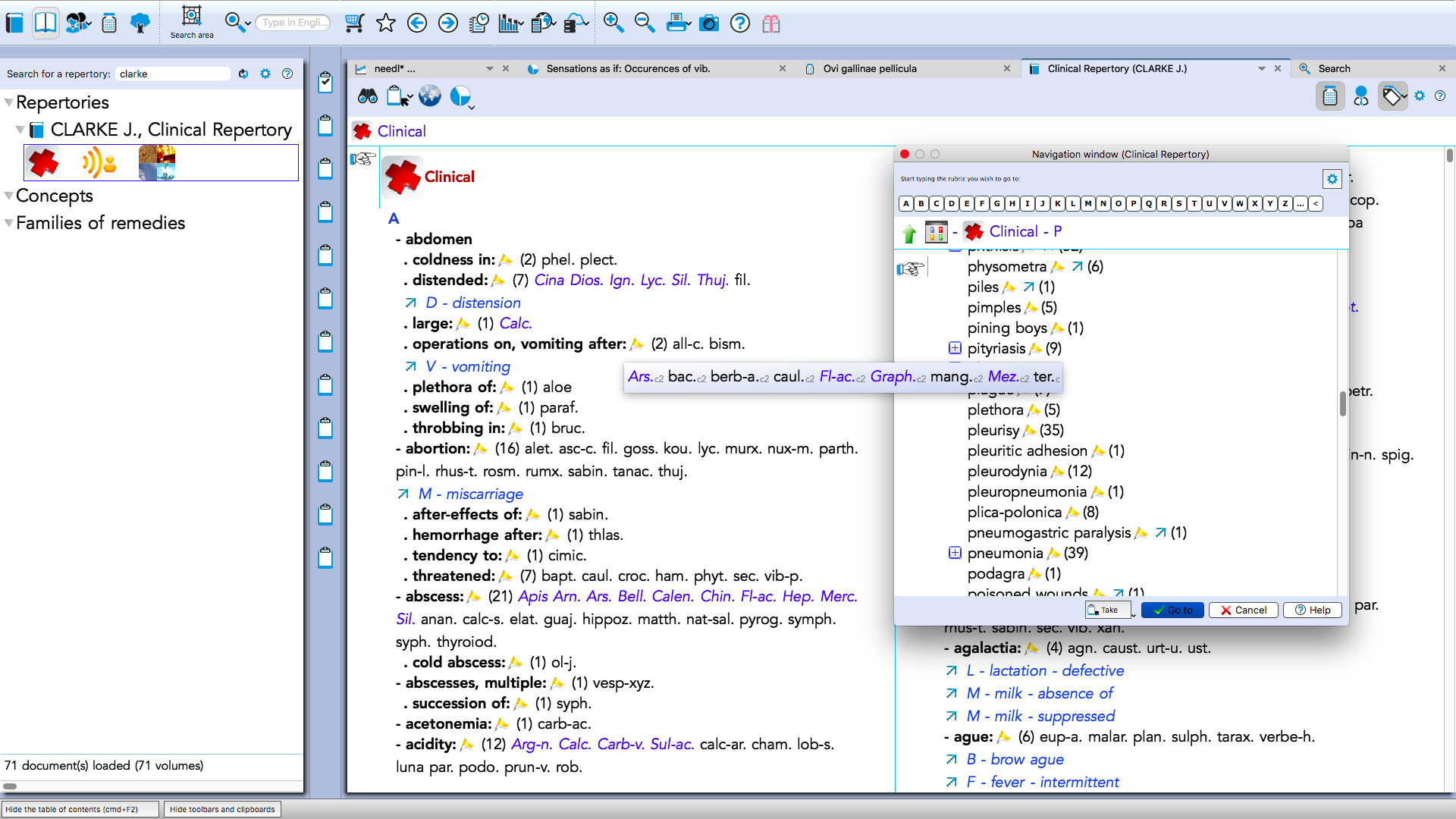
The historical screenshot above shows Clarke’s alphabetical Clinical section in RadarOpus in 2020. It preserves the context of the original tutorial; current controls may differ. The accompanying official gallery contains the original comparison demonstrations for readers who want to follow the sequence.
Read the Clarke introduction and comparison gallery, or explore the wider classical repertory collection.
Adapted from Luke Norland’s Zeus Soft teaching newsletter of 21 November 2020, with the accompanying repertory reading.
This article is for educational purposes and does not replace individual medical advice. Seek appropriate medical care for health concerns and continue any prescribed treatment.