Boericke’s Repertory: following cause, character and context
Boericke’s Repertory was the second stop in our autumn 2020 classical-repertory series. The newsletter drew attention to its smaller remedies and single-remedy rubrics. The accompanying teaching page explains how to approach that material through the structure of the book, rather than through the size of a remedy list alone.
Understand the clinical arrangement
Boericke’s is a clinical index, with technical and diagnostic language among its headings. That makes its organisation different from a repertory built chiefly around a long hierarchy of subjective symptoms. The accompanying commentary by Elizabeth Wright-Hubbard distinguishes the common or diagnostic features of an account from its subjective qualities, modalities and generals.
Under a broad heading, the reader may find subdivisions for cause, type, location, the character of pain, accompanying symptoms, and aggravating or ameliorating circumstances. A familiar heading is therefore a starting point. Reading the subdivisions shows how much further the account is qualified.
Follow the wording of a cause
The original RadarOpus demonstration suggests searching Boericke’s for words such as cause, after or complaints to see how these relationships are indexed. One exact example given there is:
EARS - Deafness, hardness of hearing - Cause - Concussion
This is a demonstration of repertory organisation, not advice for managing a head injury or hearing loss. Read from the broad entry to its final qualifier: the last words change the meaning of the whole path. That is the point of preserving the path rather than copying only the terminal word into study notes.
Keep the entry connected to its literature
The newsletter’s interest in smaller remedies was an invitation to widen reading. A short rubric can bring an unfamiliar name into view; the next task is to read the underlying Materia Medica and understand the description in its context. The number of entries attached to a remedy does not, by itself, explain the entry you are reading.
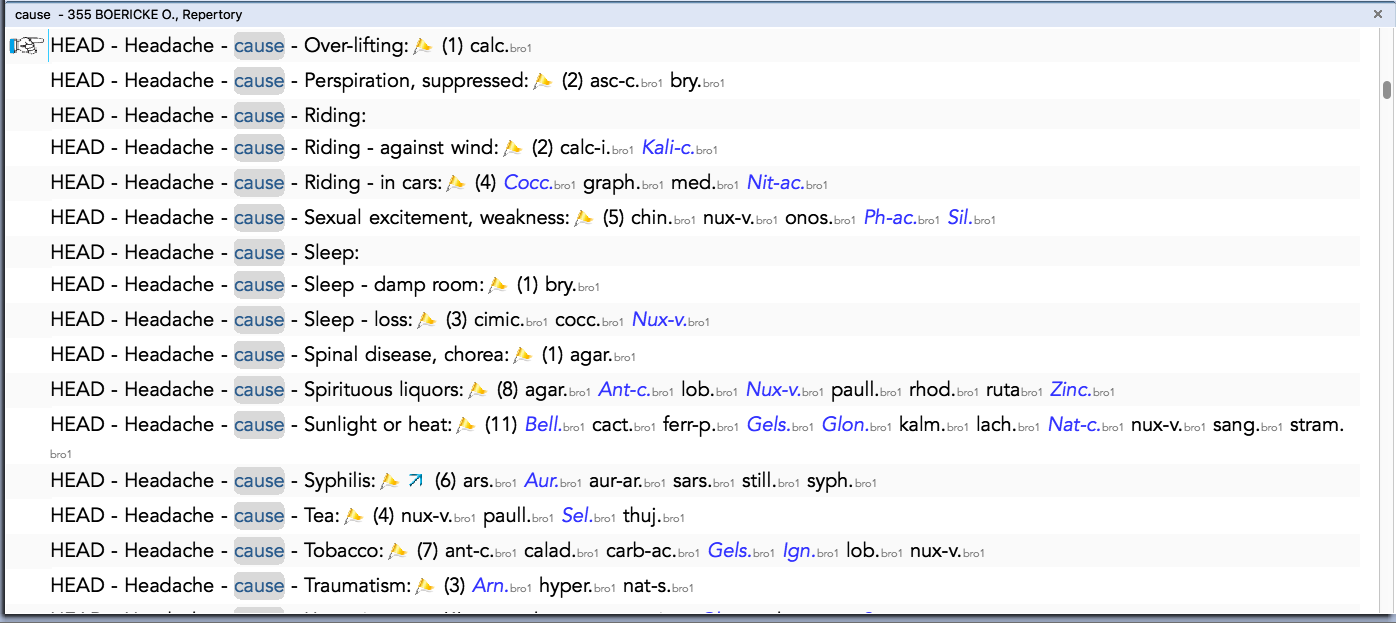
The publisher’s illustration above shows repertory results for the word cause; present-day controls may look different. The teaching point is the structure of Boericke’s material, rather than a particular toolbar arrangement.
Read the Boericke introduction and original gallery. For an overview of the collection, see the classical repertories guide.
Adapted from Luke Norland’s Zeus Soft teaching newsletter of 31 October 2020, with the accompanying repertory reading.
This article is for educational purposes and does not replace individual medical advice. Seek appropriate medical care for health concerns and continue any prescribed treatment.